This week was the start of the Graded Team Rounds, I was nervous and excited at the same time. Eagerly awaiting the first two rounds to be submitted. I’m working on team chester, and I’m really happy with my group at the moment. They both put in more than their fair share of work and they really add their two cents even if we disagree. We’ve already changed our strategy multiple times to be able to adjust to industry demand. Its great being able to work on a team that is willing to accept changes as need be.
Reflection
Looking back this week on the team rounds and the practice team rounds I can see that there were several things that we were able to improve on. We noticed that our prices were pretty high because of the product placement in low tech, so we’ve decided to change that up and lower the placement. We’ll be trying for a revision every 3 to 5 years, so we’re trying to get it so the product is right at the edge of the low cut when we revise it and it will have about 4 maybe even 5 years old. We might lose some sales when we revise but we’ll plan on lowering the forecast.
Identifying key learnings
Something that I don’t want to forget is our high tech strategy. Entering high tech and getting the right customer survey score and then getting the right product market share. We are still testing this out in the rounds but it’ll be interesting to see how much market share we can get in the next round. Ideally I’d like 18% but I don’t know if that is possible. If we make it we’ll do great but if not we’ll crash pretty hard.
Action Planning
For some specific actions I’d like to apply are first giving more time and responsibility to the other team members. They are very talented team mates and I trust them to make great decisions in the company.
For evaluation criteria, I’ll see how they are doing in capsim and help them make the right choices.
The measurement procedures are straightforward with capsim we can just see at the end of the round how we did.
Applying
Now, it’s just up to me to apply these things this week as we work through rounds 3 and 4. I’m excited to see what my other two teammates will come up with. I’d like to see how our strategies play out and how well we are able to do as a team against the others. We’ve had some fantastic competition this round and I’m looking forward to see how these group rounds play out.
$100 Challenge
This week on the $100 challenge I was able to sell another 4 bowls for $60 bring my total sales revenue up to 291, and profits to 271. It also looks like I wasn’t able earn more than $500 by the end of October. This is contributed to the lack of time I was able to contribute to the project. In the last few weeks I’ve only been able to put in minimal hours to the project to keep up with the rest of my school work. Again I find myself falling behind in my school work, requiring more work to be completed on the weekends.
I was happy about this sale because Kay seemed very interested in the bowls with the bark on the outside, buying three of them. They seem to be fairly popular. Looking at my inventory I think I only have one bowl left so I’ll need to replenish my stock before I can sell more bowls. It seems like the number one factor contributing to lack of sales is just lack of product. I simply need to make more bowls.
On the plus side I figure that it is okay that I’m not able to put much more time into the bowls to give my other classmates a little bit of a head start. I would like to get busy in the next few weeks to come to take advantage more of the christmas sales. Looking at my schedule, this Saturday is already full, and Saturday’s are really the only days I can turn bowls because of my school work.
Friday, October 21, 2016
Lessons Learned 21 October
This week has gone by very fast. With all the projects and assignments to be done and completed I’m glad I made it this far. As I mentioned last week, working on the $100 project has been a great challenge because of managing time. With my current class schedule I just don’t have time to work on the project, but that’s why I’m writing this on Friday, so my hope is tomorrow I’ll be able to go up and turn some bowls. This week, other than the elevator pitch I have not worked on the project. I figure that this is acceptable at the moment because I am ahead of schedule. Hopefully in the next few weeks I can slowly work on the project and fill the orders that I have. The biggest failure I’m having at the moment is the time to put into this sample company. I’m finding it very difficult to put time into another business, even if that business is making money. The reality is if I could pursue this business I could see it being profitable. My goal would be to create about a thousand dollars worth of profit a month. I’m thinking I should really start working toward this kind of goal because if I can achieve that then I’ll be able to invest more time into the project and also invest more resources. I knew going in that time was going to be the issue, so it's all about now making the most of the little time I have.
The greatest challenge is going to be time management. I understood this going into this class but it has really been a challenge this week. With my business MINDS-i, I’ve worked over 71 hours this week. I’ve been struggling to keep up with my classes and to be honest I’m surprised that it’s only Saturday and everything is practically done minus the discussion board posts. Despite the excellent material in this course I find myself struggling with the material not because it’s challenge but because I believe that most of the work is unnecessarily redundant. The discussion board posts seem to be the worst of it, requiring students to post multiple times and multiple days. I can see how it has a great intention of having an ongoing discussion but it just doesn’t work out that way. I’m a little disappointed in my $100 challenge because I have a great product and business, plenty of work to do and plenty of money to be made but I just don’t have the time to do it because I’ve spend all of my time writing about my plans, commenting on discussion boards, and all the other work in this class. This week I’ve done nothing for my project, except the assignment of setting a budget. I did manage to raise $20 for the project, and print stock certificates but that’s basically a novelty item. I also don’t really need to raise money for the project considering I’ve already sold over $200 worth of bowls with another $100 just waiting to be made. In short, the business is great but I just don’t have the time to make money. At this point I’ve considered hiring someone to just turn the bowls for me and paying them whatever. Considering the high margins on the bowls, if I sold a bowl for $20 and it took 1 hour per bowl I could afford to pay the Washington state minimum wage of $9.47. That would leave me with a contribution margin of 53%, which is not bad. That could be an option, looks like this is all that I have time for today, now to do some discussion board posts.
Capsim has been really challenging this week. I made a few mistakes this week mostly in forecasting and it really has not paid off. When it comes to planning for the worst case scenario, I really need to be true to that. In both the 3rd and 4th round I was confident that I could increase my low tech market share by 2% and and in both cases I was wrong. In the second case I even had the best product, but I couldn’t see it because of I was unable to produce the right amount with the revision date so late in the year. I’m sad about that because I had so much automation my R&D times were horrible so the smallest revision, put the product at the end of the year. My second product actually did better than the first, able. Able by the way has a 54% contribution margin in the low tech. That’s with an automation of 10, but I admit I layed off some workers to get that variable cost down.
Reflection
Reflecting on these experiences I hope that I’m able to do better in the team rounds. I feel like I really got off to a bad start in the first round by not taking out loans, which lead to a lower leverage ratio. I was struggling to get that back up and surprisingly, by taking out the emergency loan I was able to get that up to the ideal zone. But after two emergency loans of $20,000 I wasn’t able to make a profit, which was disappointing. I was able to get back market share, so I believe if this were to go to eight rounds I might be able to pull it back.
Identifying Key Learnings
I’d say one of the key learnings was the customer survey score, after the huge disappointment in round 3 I went pack to the drawing board and really looked at why my products and done so poorly. Basically what happened is that I had forecasted for a market share of 22% but had cut back the quality of the MTBF to a minimum. This was a huge mistake in the low tech segment, who relies on quality, so my 20% market was cut back to 15% and the fourth round was 13% even with product modifications. However the fourth round was mostly held back do to a late revision date. Again, in the fourth round I was too optimistic, if I had forecasted at 15% I would have been right on the mark. I would have guessed I’d sell around 1243 including 45 days of extra inventory. I actually sold 995 which would have left me with 248 units of inventory, about 91 days of inventory. A little high but better than the current 200 days of inventory. Which caused another emergency loan. Worst case scenario is now my new best friend.
Action Planning
Planning from here on out I’ll have to go with the worst case. This may mean I’m more likely to stock out but stocking out is better than getting an emergency loan. As I demonstrated in round 4, sometime the worst case is still too high if the product drops market share unexpectedly. To help out with this I’ve made a rudimentary customer survey score calculator. It really only works for for price and MTBF, where it is really hard to tell how many points a product loses with every 0.1 the product is away in the perceptual map and in age. I think I’ll try a few practice rounds to see if I can get any difference.
Applying
As I’ve discussed there are several ways that I can apply the lessons I’ve learned this week. From relying on the worst case scenario, to not discounting the MTBF in the Low tech. I’m excited to try out these new concepts in the next team stage.
$100 Project Progress
I have officially completed the $100 challenge, I’ll have to rename it the $500 challenge because I’ve already passed 100 and 200 so my next goal is to earn $500. I’m sure that I’ll be able to do it by the end of october too. Right now I have at least $120 on custom orders to fill. That’s the worst case, charging $10 a bowl. My average sell price has been around $17.50 meaning that the next 12 bowls could turn into $200 to $300. I could not have had this success without the help of my family and the very generous donations from my customers. I was impressed with the value that they were able to see in my bowls. Their generosity encourages me to make better bowls. I’ve also come up with the idea to include a lifetime warranty on all the bowls. That way if ever one does break, I’d be happy to turn another for them. This week I’ve only sold 5 bowls and from that it’s generated over $200. To be exact my net income as of October 7 is $211.67. I’m excited to donate all this profit to a charity. I hope it will really make a difference is their life. I’ll make sure to find a great charity. I also sent out a few posts to my other classmates because I’d like to know how they are doing. I hope I’m not too far ahead of anyone so I’ve decided to help anyone out. I put my phone number in the discussion board so anyone can call me with any help they need. Hopefully this lead in the $500 challenge will help me catch up with my other classwork. I’ve really been learning quite a few things in this practical challenge, and I hope to continue to grow the business even though I’ll be taking it a little bit slower.
Sunday, October 2, 2016
This week the $100 challenge is doing great. I’ve struggled
to manage enough time to work on the project with my assignments. As I write
this at 6:41PM on a Sunday Night I have struggled to complete my assignments on
time. Working to 11PM every night isn’t good enough. I’ll need to somehow work
more hours to get all my work done, I’m planning for 16 hour days during the
week and I’ll have to extend that to the weekend. That would put me at 8 hours
at work and 8 hours after work for school. Coupled with more time I’ll need to
manage my time better. I’ll need to get right into the business of my
assignments and not waste time. Another big problems is paying attention to
deadlines. For the second time in this class I missed a discussion post that
was incorrectly marked as due on the following Monday but should have been
completed on this weeks Tuesday, and then allow for three days of follow up
posts. I had to give up time on Saturday, time I had set aside to work on my
business to complete a trivial assignment that should have been completed on
Tuesday. On Saturday I was still able to list a few more bowls on the site and
do a little a little sharing on facebook.Tim’s
Wood Bowls now has six bowls listed, it wasn’t the 10 bowls I had hoped,
but I’ve set aside a few bowls for a few interested customers. If these sales
go through I could likely generate a hundred dollars in profit this week, but
it remains to be seen. I’m slightly discouraged about the etsy site, because of
all the fees involved for listing and selling. Also shipping has been a pain.
After taking a look at shipping, it seems that their shipping rates are aren’t
working correct. Most of the shipping prices are overpriced, and even with the
overcharging, the shipping prices were still inaccurate. For example the first
bowl charged $5.54 on etsy but the actual cost was $6.80. I could add more to
shipping but that would just lead to overpriced shipping problem. My brother
who lives in Arizona came to visit over the weekend pointed out that it would
cost over $15 to ship a $15 bowl to his address. This would end up discouraging
customers to buy our bowls, when they were expecting to pay around $15 for a
bowl but were charged twice that. We came to the conclusion that the prices
were over the top for shipping, so we decided to change our strategy. Instead
of charging for the bowl and shipping we would offer free shipping, allowing
for the price displayed on the first page of the site to be the final price.
This works out for us because we have a large supply of wood for the bowls so
really the only expense is the shipping and whatever fees are charged by Etsy
for listing and selling the bowl. In the end this should work out fine if we
can keep the shipping price down and it will help give the customer an honest,
square price.
It's been an incredibly long week but I have learned many great lessons so let's get started.
Surprisingly one of the biggest lessons I have learn was from the 5 minute video by Guy Kawasaki. He said simple make a meaning and a mantra and through out the mission statement. I believe I've seen this video before but this time it stood out to be. It was just a few months ago that Altek, our affiliate company had taken a day to develop a mission statement, so it was surprising to me to see Guy saying not to was time on a mission statement and instead develop a mantra. A mantra is a short phrase that describes your company. It's different from a slogan, Nike's "Just do It." A mantra for Nike is actually, "Authentic Athletic Performance." I've never head of this before but this captures the essence of the organization. The great thing about a mantra is that it works for both the salesperson and the customer. This has got me thinking about MINDS-i's mantra. I've noodled over this a bit and came up with and came up with: Teaching STEM through Robotics. I'm not completely convinced but it's the best I've got so far and it's better than what I've been using. Just the other day I said that and instantly caught the persons attention. I'll try it more often.
The $100 challenge. In my class we have been asked to start a small start-up with $20 with hopes to raise $100 dollars in profit. I think that it will be a great challenge as I have never run my own business or raised that much, so if I can do it, it will be a huge confidence boost. My plan is to turn wood bowls on the lathe. My dad has been turning bowls for a few years and has always wanted to start selling them so I thought that this was a great way to get the business started for him. There is really no cost on my end, except the time to turn the bowls. I really hope that this turns into a successful business. I made a shop on Etsy called Tim's Wood Bowls. Go and have a look and buy a bowl for charity. I sold my first bowl on Etsy this week, to my brother Chris, who was very excited to get started on the shop. I've also had a few other messages about people interested in buying bowls. I haven't had much time to set up the shop, turn bowls, or pursue any leads just because my schedule has been very full with all my classes and work. Right now I have another six bowls that I need to list on the website. The biggest challenge is going to be spending time on this project.
MINDS-i has been busy the past week, this Saturday is the BSA STEM University. I teach the robotics merit badge. We've developed a new inexpensive kit and made it available to the scouts. That in itself is quite the project. Today I took the time to contact every scout to make sure that they were prepared for the class. I was able to help them get the robot kit that they needed to complete the merit badge. I hope that each scout, leader, and parent can know the great service that we are doing for this. I look at this course almost like a college level class, but adjusted so that an 11 year student and understand it. It's important to note that it's not so much that the class is easy, but I am increasingly surprised at the enthusiasm of the scouts. Even at a young age they are capable of understanding this course. It is a fantastic merit badge that will teach them and hopefully get them excited about the world of robotics. I'm glad I have the chance to teach it. Hopefully, they'll be a bit more prepared this year. Bringing this back to the thoughts from Guy Kawasaki, he mentioned that the purpose of a business is make a meaning. My hope is that both Tim's Wood Bowls and MINDS-i is a part of making that meaning.
1.Go to the system: Kremainn, and dock at the station:
Wholer Terminal.
2.Hunt for bounties in the “Resource Extraction
Site” or RES, This is found in the one of the Ringed planets closest to the
station.
a.Stay
close to the security forces as they will help you take down enemies.
b.When
you are low on hit points or want to cash in the bounties head back to the
station.
c.Feel
free to upgrade modules and even buy better ships as you earn more credits.
d.The
goal is to gain over 2 to 4 million credits.
3.Buy and Upgrade the Type 6 Transporter following
this
guide.
a.Feel
free to modify as needed, you may want shields, a bigger fuel scoop, hard
points, or utilities.
b.If
you just wanted to get into basic trading, only 2 million is needed. Search for
a system using the Thrudds trading Tool and trade.
c.You
can earn 1 to 2 million per hour doing basic trade missions.
4.For those long distance missions, head to CEOS
and SOTHIS.
a.It’s
around 500ly so prepare for long range. It’s about a 20 jump trip so 20 minutes
in travel time.
b.Run
“Boom Data Missions” between the two system to increase your reputation.
c.When
you have enough reputation, missions will pop up giving you around 1 million apiece,
take as many as you can and trade between populated space and CEOS/SOTHIS.
d.You
can earn 5 to 10 million per hour doing these missions. (Possibly up to 50
million if you have an anaconda.)
"I don't always do something stupid, but when I do I make sure to post it on the internet so everyone can laugh with me."
My most recent goal has been to build a FPV Racing Quadcopter as folows:
FPV Racing Quadcopter
My intent with this project is to develop and build a 250mm
FPV Racing Quad copter. I’ll put resources and links as I find them available.
Initial challenges with the MINDS-i system will be making the frame small and
lightweight enough for 5-6in propellers to provide ample thrust to weight
ratio.
As you can tell my original design was to use the MINDS-i pieces. The main problem is plastic flex, will the frame bend too much? With a little inspiration from Tested I had a good idea of what I needed to do. So I went and built this:
Here it is! I used the colored beams to mimic the flight lights on modern aircraft. (I didn't have any green beams, so I used blue.) Evenually, I'd like to use some LED's but let's just get this thing tuned and flying first. The reason for this color coordination is so that I will always know which way my quad is facing. On this I'm using the 10x4.7 props, so it's actually pretty overpowered for a small copter. It's about 12in wide and long so it is much bigger than the 250mm class quad but it's a good place to start.
I'm using the same top and bottom plates as the MINDS-i kit uses but the plates are mixmatched as to make it as sort as possible. One bottom plate and one top plate is used on the topside as shown, and mirrored on the bottom. This allowed me to remove a few spaces in the overall length. This is using the APM board with external GPS and it has a 4 cell 2250mAh battery. I'm using the other stock 1100 KV motors and 30 amp esc's on the MINDS-i kit. Testing this showed that it was completely overpowered, because of the smaller frame. Here are a few notes from my initial tunning:
PID TUNING - 12/14/15
Unsuccessful attempts at PID Tuning the quad. Changing
multiple values appears to not make any effects. In most cases it flies
normally until the error ramps up, (about 5 to 10 secs), the quad will continue
to shake back and forth uncontrollably. Changing the D seems to make the most
difference controlling how fast the quad shakes the higher the value the
faster. (D= 0.001 to 0.008. D=0.004
seems to be the best) However, no setting appears to work. We also tried the
Auto Tune function but it would deactivate the moment it was armed.
Thoughts?
I may need to set the P value below 0.08.
I would like to try auto tune again, see if it will work.
The flex in the frame may be causing it to shake.
After doing a little bit of research on these sites I returned to tuning the next day.
The tuning seems to be going better. I think I can negate
the up and down wobble from the string and focus on getting the “shakes” out.
It seems to almost be flyable.
From DIYDrones I’ve found the following excerpt helpful.
Starting with D.
“I’ve found the quickest way to tune the arducopter is to
start with rate_D, (but you simply can’t do this unless you can hold your beast
in hand or in a jig as the copter won’t fly without any rate_P or I) so a more
universal way to start, and actually a more informative way is to start with
rate_P.
STEP TWO – Tuning rate_D
1.You have found a nice rate_P value
(or so you think), so leave that fixed for now. For example 0.110
2.Set a range of rate_D from 0.000 to
0.025.
3.Throttle up in hand with rate_D at
0.000, things should be as you left them at the end of step one.
4.Now start turning up rate_D, again
move the sticks, shake the beast about, you will notice that at a fairly
precise point you start to see very fast oscillations. This is your maximum
rate_D, I’d set it just under where you can induce these fast oscillations by
moving the sticks fast of shaking a leg.
5.Now you can go back to rate_P and
tune that again, you should be able to increase it considerably!!! So to step
three.
NOTE: once you have
found your rate_D you can try something interesting - you will have to hold
onto your bird for this obviously. Set rate_P to zero, then crank up your
rate_D as you just have. You will discover that these fast oscillations occur
at pretty much the same level of rate_D, no matter what you have set rate_P to.
This is why I think it’s more than possible to start
tuning rate_D then move on to P. But that’s a shortcut, and
this is not what this guide is all about.”
What I did:
Tuned D to 0.003
Tuned P to 0.087
After a few test flights, it wasn't working at all, it would either not arm at all or when did it was very under-powered. To fix the problem I went back and redid all of the calibration and parameters.
12/16/15
Yesterday: After resetting all of the parameters, re
installing the firmware and re calibrating the quad it flew very nice. I was
able to fly it most of the day.
Originally the error were that it would not get off of the
ground, like the throttle was limited. It also had the problem of it arming and
then disarming.
After I got it flying I took it out several times. There
were several crashes. It would fly well for about five to seven minutes but
then it would twist and fall out of the sky. It think it has something to do
with the low voltage failsafe not being set correctly but it’s hard to tell.
The PID seems to be set fairly well. Its flight
is very smooth. It seems to wander a bit and it does tend to shake a little in
the wind, but it is able to maintain flight and I feel like I have very good
control over the air craft. I think I’m done tuning the PID for now. I can
focus on fixing the failsafe.
I was able to fly it for most of the day on the 15th and the 16th testing how it flew and handled. However that night I took it home to practice flying it a little more and disaster struck. I write about my experience the next day:
12/17/15
Well I lost it. It last saw it floating off in the distance
just to the north east of my house. I searched hours for it but no luck. Time
to think about GPS Tracking.
To add a little bit more to the entry, I remember it flying it in circles, trying to get used to using the yaw in different directions. Flying it towards me and away from me. All the time it was in stabilize mode or in altitude mode. After flying a flew loops it slowly got higher and higher. I tried to bring it lower but there were several trees I had to avoid. At one point it started to drift and because I was not sure which way was the front when I went to correct it's course it drifted in the wrong direction until it was out of sight and drifted behind a tree. At that point I went to run to catch up to it and by the time I got there it had either drifted far from that location or crashed. I searched for hours after that but was unable to find it.
I continued to search for the quad in the days to follow. Talking to many neighbors and passing out my business cards and contact information to anyone I could talk to. I even mapped out a search area and highlighted the area I visited as well as the red areas where I could not get to, I then went and checked all the red areas the next day, but with no luck. That weekend there was some good snowfall so wherever it went was likely under snow, I continued to search through the weekend with no luck.
Since then I've started to practice more on the flight simulator Phoenix R/C version 5.5.i. I've also moved to a smaller model. This little micro quad I got for Christmas. Thank you Merrill and Rachel!
Between the simulator and this micro quad I've tried to fly every single day since the accident. I've also taken some tips from Flite Test to start in Acrobatic mode, or Agile mode. I've started that on the flight simulator and seems much more manageable now. Since then I've been following these tips in this video to be helpful.
That's my story, in the days to follow I've continued to practice flying. I've also thought about what my new quad is going to look like and laid out an initial design. I try to update this post regularly so I can keep track of my progress and research.
My newest project:
Levi came up with this design. After flying it around and testing it for a few weeks he'd like to make a few changes and I'd like to build a new quad so with that extra carbon fiber sheet we'll have to make another quad like this.
The future design will have shorter stand off's so the quad height will be lower. Levi noticed that there was plenty of space in the middle so we'd like to chop off another 0.4 in off the height. We'll have to make a few custom length stand off's instead of using the MINDS-i threaded collars but that should be simple enough. Another change is to cut out as much weight as possible while still maintaining the strength.
I'll need to get a few things to complete this quad, namely:
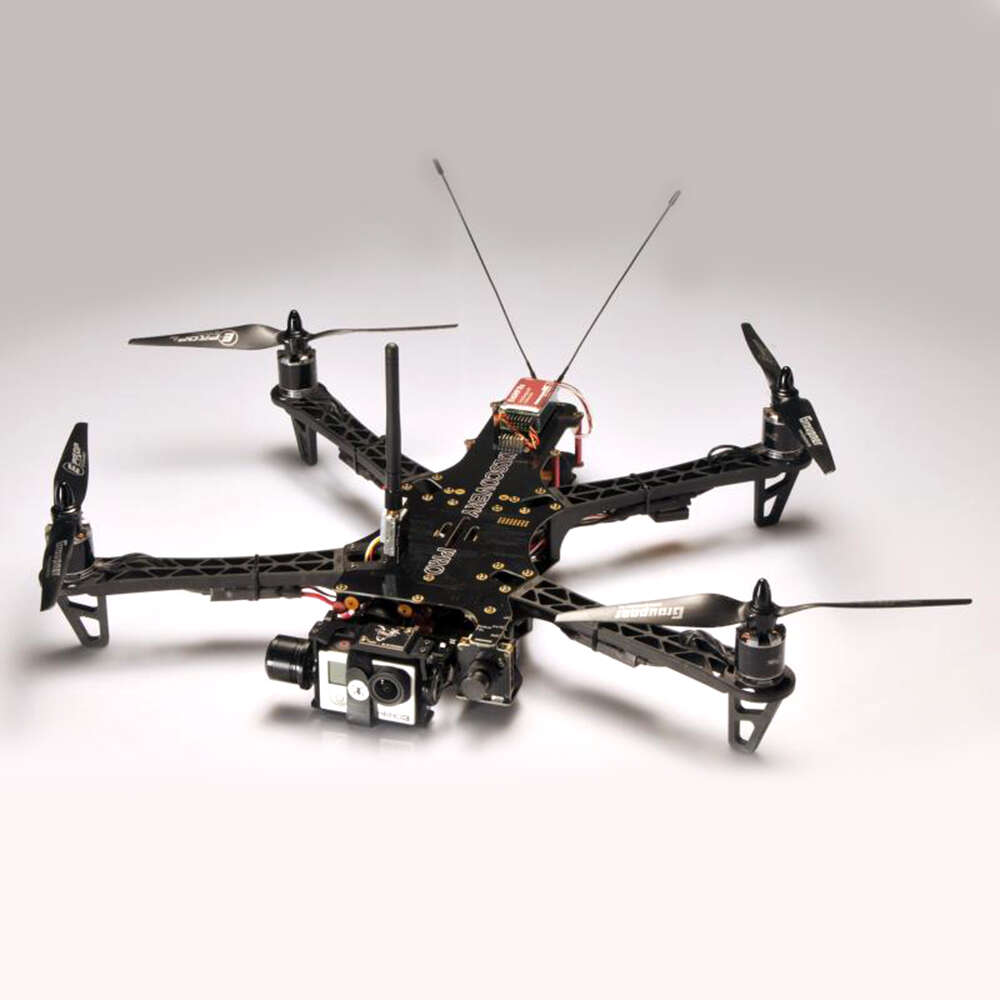
Looking at some more quads today I found the TBS Discovery Pro Gimbal Frame, this is from Team Black Sheep.
This was designed for amateur and pro aerial videographers, the key feature to this is that it has a fully stabilized camera gimbal.
A great starting FPV wing similar to the Teksumo is the TBS Caipirinha. Much more expensive. The reason behind it seems to be a 35 minute flight time with a range of 10km. Fully decked out it's $351.60.
Monday, December 28, 2015
I'm working on some research on a FPV racing multi rotor and different types and options that are out there.
On another note, I really see tow main branches of quadcopter that I'd like to look into first it the quadcopter racing and the next is photography.
This caught my eye because its small, folding, able to fit in a small backpack, flies very stable and has autonomous flight and tracking at a fairly inexpensive price.
A few Racing multi rotors I've been looking at are these:
This multi-rotor from RC timer seems like a cheap way to get into racing multi rotors.
The Tecsumo might also be a great plane to start out with FPV.
Tuesday, December 15, 2015
Productivity Pyramid
Values, Long Term Goals, Short Term Goals, Daily tasks
It’s taken me all semester to really understand the power of the productivity pyramid but I’ve really really thought about it this way. I’ve always understood long term and short term goals but what I had a hard time learning is the daily tasks are the most important. Jim Richie broke this down in such a way that I could see they are the most valuable. There are 1440 minutes in a day, these we call productivity points. We must use them wisely to work toward our long term and short terms goals. Everything we do in our day should lead up to those points. This is not to say there is not time for rest or leisure or time to enjoy the joys of life, in fact these should add up to our goals. These day to day tasks are important on the path to mastery, and it’s not always necessary to see the end goal or reap a fast profit. Sometimes it is the little things that add up to the big things. Those day to day tasks add up in the end and separate the masters from the rest.
The plan of happiness are some other very good points I have learned to love. These principles have taught me a lifestyle that by such things a person could conquer the world. They are:
1. Get up early.
2. Work hard.
3. Get your education.
4. Find oil.
5. Make your mark.
6. Prepare to serve / give back.
The principle of getting up early is simple but something I have always struggled with. The first step of being successful is getting up early. The next is to work hard. I would also add with working hard, work smart. The third is to get an education, not just a formal education but become a master learner in all that you do. As we continue to work hard and learn we will find our oil. Oil for me means finding that passion that corresponds with my talents. Making your mark, is the path to mastery. Unlocking those talents and using that passion as fuel from day to day we can make our mark and allow us to rise to the top. I believe making your is also in part to making a difference. The last point is to serve and give back. In light of the story of Thomas S. Monaghan, the founder of Domino’s his life is an example of giving back. In the end we must keep this value as the most important of all our daily tasks, to serve and give back.
May these two tools, the productivity pyramid and the plan of happiness aid you on your hero’s journey, and may they bless you as you continue your ministry of business.
Saturday, December 12, 2015
I learned quite a few things from the Randy Haykin, the Making of an Entrepreneur so I thought I would include a few things.
Randy Haykin: The Making of an Entrepreneur.
How did being a lifelong learner benefit Haykin's career? How could it benefit yours?
He placed a high priority on spending quality time at home with his family.
He started working at Apple Computer in sales. Eventually, he created the Apple Multimedia Developer Program. He also created a New Media Center program for higher education.
He became the director of Operation and Business Development at Viacom/Paramount’s operations, (the “Media Kitchen”)
Haykin founded Interactive Minds, “to meet this unmet need” of teach companies how to put multimedia technologies and the Internet into practice. Over time it evolved into a “venture catalyst”
“In my first year at Interactive MINDS, I tripled my salary and found myself doing amazing project with total choice and control over what I was doing.”
“The biggest challenge of the entrepreneurial situation was balancing family and work.”
Haykin convinced Carl Nichols, to join the company, and he became a partner thereafter.
“To me, a leader is someone who sets the creative direction for a concept and can harness the human resources to turn that concept into a reality, in essence, a leader is someone who creates something from nothing.”
He gained inspiration from Steve Jobs.
What was Haykin's "toughest hurdle" as a business leader? Why do the risks of entrepreneurship seem worth it (or not worth it) to you?
Toughest Hurdle: a start-up that didn’t go so well.
“The toughest hurdle that I have faced as a leader was one particular case
with a start-up where things just did not look like they were going in the right
direction. We ended up selling out earlier than we really would have liked. Some of
the funding that we had expected to come in was pulled, so we were left without a
way of keeping the company going. It felt like a failure. It was heartbreaking to have
to tell a team of fifteen people who had just put their hearts and souls into this project
for the last twelve months of their lives, which we all thought was going to have a big
payoff, that: “Now it is time to close this project down. It did not work, and it is
being sold off. You no longer have a job.” But I'd imagine it's an ongoing part of the
entrepreneurial process. Most venture capitalists will tell you that of ten deals that
they'll do, on average, two will be total failures, two will be not so great, and
somewhere between the remainder of one and six are going to be successful or
moderately successful. So, I know already going into the entrepreneurial situation
that something is going to fail. It still hurts, though, when you're going through it,
and real people are involved. You just feel like you misled people, or you could have
done a better job as a leader.”
Another struggle was his work/Life Balance. “In a typical week, I work 50-60 hours. I try to leave my office (which adjoins
my home) by 6 o’clock. I am on the road nearly every day, but I take very few
overnight trips, maybe one trip each month. I am never quite happy with the balance
in my own life and I am always trying to tinker with it. This includes person/work,
family/work, spiritual/work, and health/work balances. For example, making my
family or my health a priority is always a focus, but actually battling to keep these
things in perspective as I go through a busy week is not easy, nor am I always
successful. At any given stage in my family’s evolution, I’m striving to figure out
what my kids and my wife need. It proves very difficult. Even doing the simplest of
things like remembering to bring my wife flowers on a Friday night takes a lot of
effort with everything else going on. I think that’s where you lose your balance, when
you forget the simple things.”
Saturday, December 5, 2015
What I learned this week:
First off, I just want everyone to watch this video, yes it's 54 minutes long, but I have never spent a better 54 minutes.
Elder Gay shares with us his heartfelt response that we all must do better in these things as entrepreneurs.
I finished reading the Hero's Journey this week. A Field Guide for the Hero's Journey by Jeff Sandefer and Rev. Robert Sirico is a inspirational book written with brief powerful stories. "a mosaic of what the greatest minds of all time had to say about nine tehemse that lead to a balanced life."To be honest I was at first confusedon why there were so many random short stories, parables, quotes and poems strung together in a book. It made it difficult to read until I could take a step back and look at the whole. As I looked at each of the nine steps I stated to see how the hero's Journey came to be, and the writings inbewteen supported the outline. Here are the nine topics:
The First Step
Who Am I, Who do I want to Become?
The importance of setting Guardrails
What Companions do you want with you on your Journey?
Stones in the Road
The Giant of Despair
Rest
Fighting the Dragon
Coming Home
What I have yet to learn:
Well there is quite a bit, but one thing I would like to point out is as weseek first the needs of others our own problems shrink. From the Hero's Journey we read "you
might be surprised to find that as you focus on someone other than
yourself, your own problems shrink; your horizons open up; your
perspective broadens and deepens.” My horizon has broadened has I have
understood this topic and listened to a talk given by Elder Gay. This has been an uplifting week as I have
been taught line upon line to seek the needs of others before my own. I
find now that it was inspiration that a few weeks ago I wrote down that
very goal, unknown to me that I would be schooled by the spirit in every
step along the way. The burning question remains, what will I do today
to live this principle?